Reinforcement Learning Showcase
Designing robust reward systems, deterministic execution environments, and policy optimization frameworks to align AI behavior with real-world efficiency.
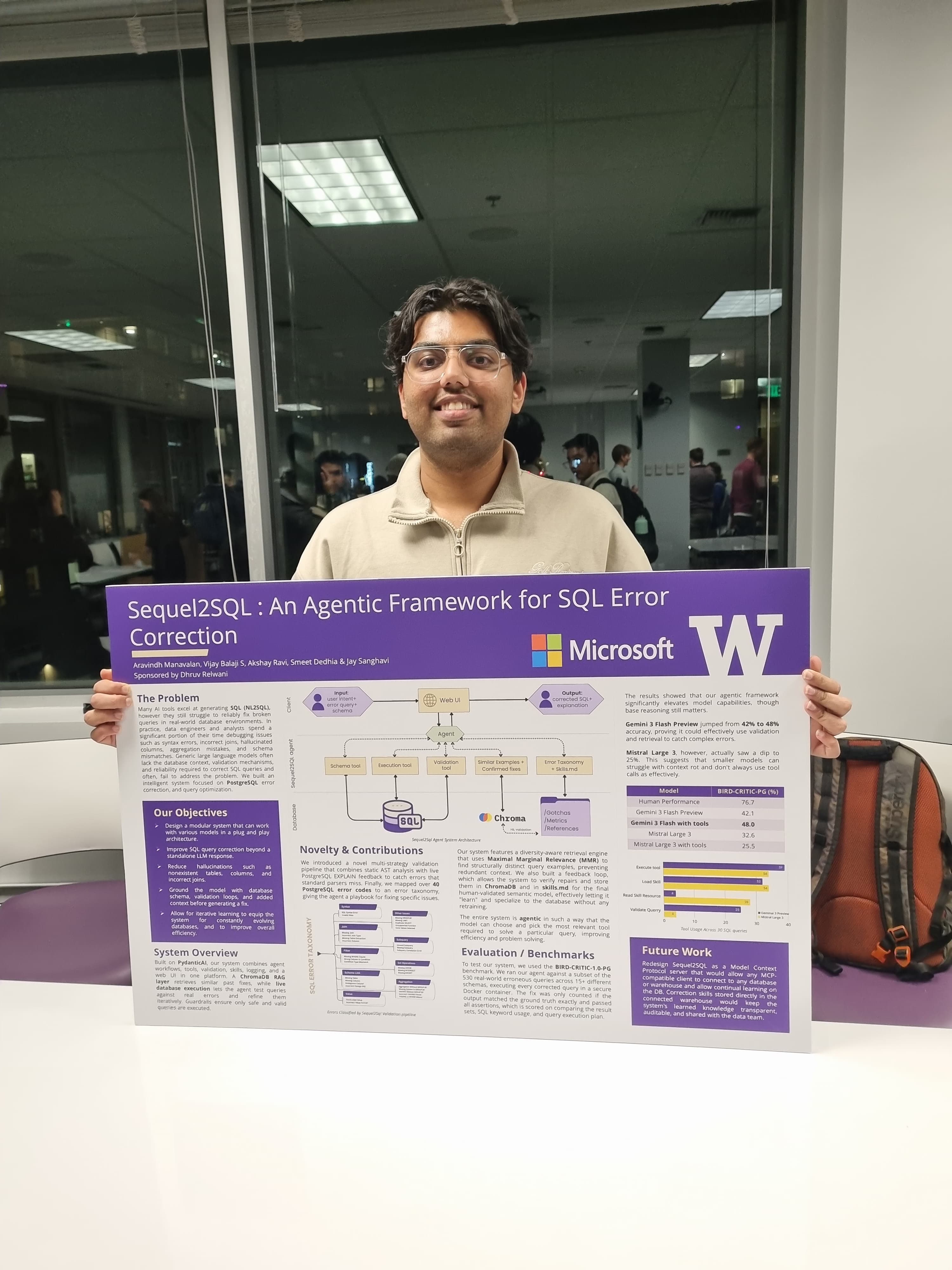
Sequel2SQL & Reinforcement Learning from Execution Feedback (RLEF)
In my capstone project, Sequel2SQL, sponsored by Microsoft, I addressed the challenge of translating natural language to SQL. While standard supervised fine-tuning generates functionally correct queries, it often produces computationally disastrous execution plans for enterprise databases (e.g., triggering massive nested loops instead of efficient hash joins).
To solve this, I designed a deterministic RLEF environment using a live PostgreSQL engine to train models in Algorithmic Refactoring. By using strict hardware execution metrics rather than a biased LLM-as-a-Judge, RLEF actively guides the LLM to write better, highly-efficient SQL that natively utilizes database indices, minimizes buffer reads, and optimizes query planner paths.
State & Action Space
- Observation: Models observe the full highly normalized schema, realistic database statistics (row counts, value estimates), and the computationally inefficient baseline query.
- Action: A two-step generation enforcing an explicit reasoning trace of query planner constraints, followed by the highly optimized SQL output.
Deterministic Reward Signal
- Query Planner Efficiency: The environment runs
EXPLAINto extract actual execution cost, rewarding the model for learning index utilization and hash joins. - Hardware I/O Analysis: Modifiers are applied based on physical disk buffer reads vs. memory hits, heavily penalizing queries that force full table scans on disk.
Mitigating Reward Hacking
RL loops in code generation are highly susceptible to agents cheating the reward system. I architected specific defenses:
Literal Matching Hacks
Implemented hidden dataset replicas to prevent models from hardcoding strings to pass equivalence checks.
Empty Result Hacks
Strict baseline comparison immediately fails queries that append LIMIT 0 to artificially lower execution time.
Planner Manipulation
Evaluated on EXPLAIN ANALYZE hardware execution, not just theoretical cost estimates.
RLHF & DPO
Leveraged Reinforcement Learning from Human Feedback and Direct Preference Optimization to align LLMs. Shifted models from generic generation to highly specialized, context-aware behaviors.
Huggingface TRL
Extensively utilized the Huggingface ecosystem, specifically the Transformer Reinforcement Learning (TRL) library, to orchestrate complex PPO loops and preference model training pipelines.
Sequel2SQL Capstone
Applied these advanced alignment techniques in a Microsoft-sponsored capstone project. Optimized language models for Natural Language to SQL translation, ensuring semantic accuracy in enterprise environments.
LLM Alignment & Preferences
Moving beyond next-token prediction, I build systems that teach models how to think. By utilizing reward models and preference optimization, I align foundational models to complex objectives where simple supervised fine-tuning falls short.
Check Code NotebookFoundational Knowledge
Classical RL Theory
Studied core reinforcement learning theory directly from the works of Barto and Sutton. Mastered Markov Decision Processes (MDPs), value iteration, and foundational policy evaluation.
Multi-Armed Bandits
Implemented and analyzed exploration vs. exploitation tradeoffs using Multi-Armed Bandit algorithms, understanding the math behind optimal action selection and regret bounds.
Deep Q-Learning
Completed intensive coursework bridging classical RL with deep neural networks. Built Deep Q-Network (DQN) agents to approximate value functions in continuous and high-dimensional state spaces.